Walk into an Ethiopian Orthodox church on Genna morning, in Addis Ababa or Washington, and most women will be wearing a Habesha kemis, a long white cotton dress with a bright woven border.
The Habesha kemis (ሀበሻ ቀሚስ) is Ethiopia’s best-known traditional dress, and a good one is still made by hand from shemma, a cotton cloth spun by women and woven by men on wooden looms. It is the dress your mother kept in plastic in the closet, the one your aunt sent from home before a cousin’s wedding, and the one many first-time buyers in the diaspora go looking for in Addis Ababa’s Shiro Meda market.
Kemis simply means “dress” in Amharic. Adding “Habesha” sets the hand-woven style apart from the factory-made clothes that filled city shops over the last century.
A thread spun at home becomes a dress
The work begins with raw cotton. In the highlands, women have long cleaned it and spun it into thread by hand. The thread then goes to the weaver, called a shemane (ሸማኔ), who sits at a pit loom with his feet working the pedals in a hole dug in the floor.
These looms make narrow strips of cloth, and that shapes the dress. To get enough fabric for a full kemis, a tailor sews several long panels side by side, then cuts and stitches the bodice, the sleeves and the long skirt. Good shemma is light and a little see-through, soft enough to move with the body and cool enough for a sunny holiday crowd, which is why a proper kemis often comes with a slip underneath.
Many of the best-known weavers in Addis Ababa are Dorze, people from the Gamo highlands of southern Ethiopia whose name has long been linked with weaving. Dorze weavers have lived on the northern edge of the capital, below the Entoto hills, since its early years in the late 1800s, and their looms helped turn Shiro Meda into the city’s cloth neighborhood.
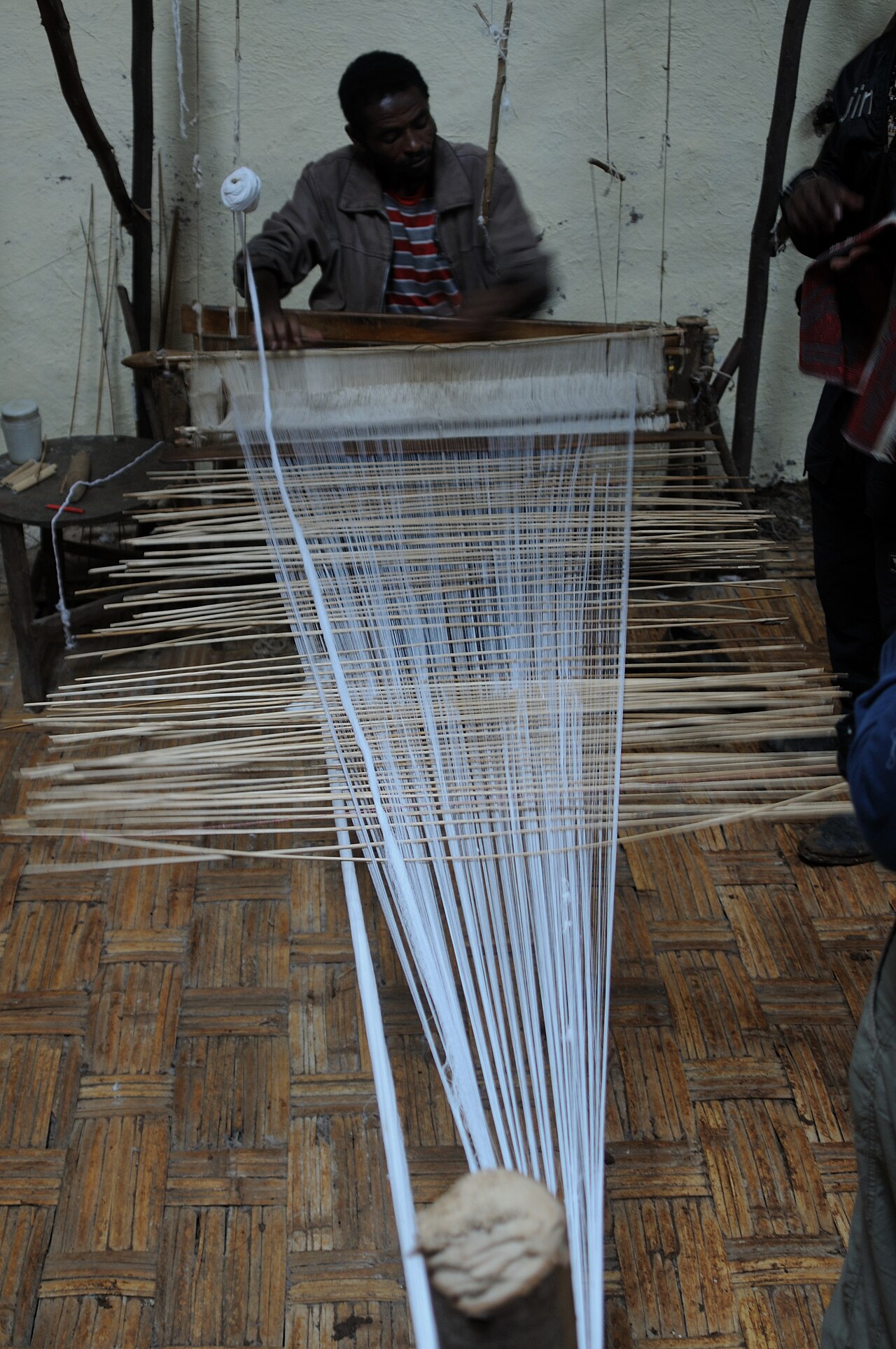
File photo: A weaver works white cotton thread on a traditional loom in Dorze, in the Gamo highlands of southern Ethiopia, in August 2011 (JosepMGracia / Wikimedia Commons, CC BY-SA 4.0)
The border that does the talking
The white cloth is the canvas. The color lives in the tibeb (ጥበብ), the patterned band woven straight into the fabric on the loom, usually along the hem, at the cuffs and down the front from the neck. A simpler single-color stripe, often red or green, is called a tilet. Embroidery added later with a needle, known as tilf, can sit on top of the woven band for an even richer look.
Older borders tended to keep to a few strong colors. These days the choices run from soft gold and silver thread to bright purple, pink and turquoise. Styles also differ by region, and Gondar, Gojjam, Wollo and Shewa each have their own looks. A wide, hand-finished tibeb is the clearest sign of how much work went into a dress.
Where the border sits matters as well. A band that runs all the way around the hem is the look most people picture. Other dresses carry a wide strip from the chest straight down to the feet, and simpler everyday versions keep the pattern to the lower half.
Shiro Meda, where the city shops for holidays
Shiro Meda sits at the foot of the Entoto hills in the north of Addis Ababa, and its road is lined with small shops hung with dresses, netelas and gabis. Before Meskel, Genna and the wedding season, the street gets crowded with families, brides-to-be and visitors from abroad trying on dresses and bargaining over borders.
Behind many of the shop fronts are workshops where the looms still clack away. The weavers face real pressure now. Machine-made cloth and imported fabric printed to look like tibeb sell for far less, and young people are slow to take up a trade that pays little for long hours. A hand-woven dress with a full tibeb can still take weeks of work, and the price shows it.
A shawl for church, a blanket for the cold
A kemis is rarely worn alone. Over the shoulders goes the netela (ነጠላ), a light shawl of thin cotton with a tibeb border at the ends. In church, women draw it up over their hair. It is also the piece most diaspora families keep on hand, since a netela goes with a plain white dress as easily as with a full kemis.
The gabi is the heavier cousin, a thick cotton wrap that works as a coat by day and a blanket by night in the cold highlands. Grandparents often wear one to early-morning church services, and plenty of diaspora homes keep one folded on the couch.
Men have their own white wear. The traditional outfit is a knee-length cotton shirt with a band collar, worn over matching trousers, with a netela or a heavier shawl called a kuta draped across the shoulders. At weddings and holidays you will see fathers and grooms in the full set, often with a fine tibeb on the collar and cuffs.
White for the feasts, color for the wedding
The calendar decides when the kemis comes out. On Enkutatash, the Ethiopian New Year in September, girls in new dresses go door to door singing Abebayehosh for coins and treats. Meskel brings white crowds to the bonfire later that month, and the winter feasts fill the streets again: Genna falls on Thursday, January 7, 2027, and Timket on Tuesday, January 19, when people in white line the routes of the church processions.
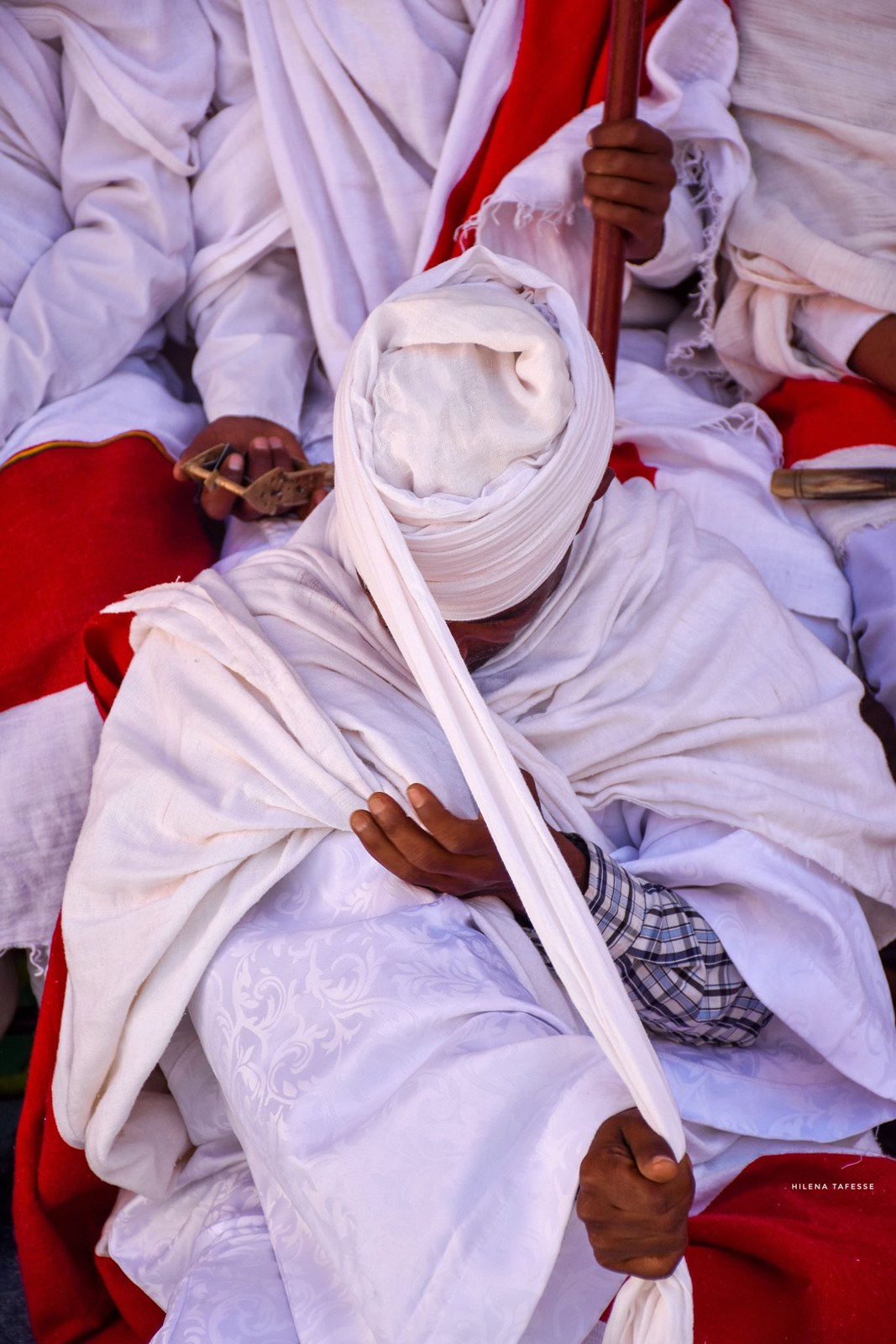
File photo: Worshippers wrapped in white shawls at a Sunday church gathering, in a picture shared in March 2022 (Photo: Hilena Tafesse)
Weddings are where the dress gets its boldest. Many couples wear Western-style clothes for the ceremony and change into traditional dress for the melse, a later celebration where brides often appear in a richly embroidered kemis with a matching cape and a gold crown or headpiece. Bridesmaids and mothers turn up in coordinated borders, and the photos end up framed on living room walls for decades.
New hands on an old dress
A new generation of designers has pulled shemma off the holiday rack and into everyday fashion. The model Liya Kebede started her label Lemlem in 2007 to give work to traditional weavers and keep their craft alive, selling hand-woven cotton dresses and beachwear around the world. In Addis Ababa, Fikirte Addis founded Yefikir Design in 2009 and showed modern takes on traditional dress at Africa Fashion Week New York, and Mahlet Afework launched Mafi Mafi in 2011, building her clothes from fabrics woven by women in rural Ethiopia. Younger labels push the look further, like the futuristic Ethiopian styling of Xufan at Africa Fashion Week London.
In the diaspora, the dress has become a way to stay close to a culture many people grew up hearing about at home. You see it at graduations, baby showers, Genna parties and wedding receptions in hotel ballrooms, sometimes in pastel shemma, sometimes cut short or fitted at the waist in ways that would surprise a grandmother in Gondar. On social media, brides from Atlanta to London plan whole color themes around their tibeb.
The Ethiopian filmmaker Yeabsira Eshetu Mandefro spent time with one of those Addis Ababa weavers, the master craftsman Getabalew Abebe, for a short film that follows his work from raw thread to finished cloth.