Hidar Tsion (ህዳር ጽዮን) falls on Monday, November 30, and at its heart is one of the boldest claims in the Christian world: that the Ark of the Covenant, the chest Moses built to hold the tablets of the law, rests in a small chapel in Axum, in northern Ethiopia.
The feast honors Mary under her title of Zion, and the Church of Our Lady Mary of Zion in Axum is where the celebration is biggest. Our guide to Hidar Tsion 2026 covers the pilgrimage, the old and new churches and how families plan the day. Behind all of it sits an older story, one that makes Axum holy ground for Ethiopian Orthodox believers and puts a copy of the Ark in every one of their churches, including the ones in Washington, Toronto and London.
A queen, a king and a son who came home
The story is told in the Kebra Nagast (ክብረ ነገሥት), “The Glory of the Kings,” a book written in Ge’ez, the old church language of Ethiopia, in the 14th century. Its centerpiece is Queen Makeda, better known to the rest of the world as the Queen of Sheba.
In the book, a merchant named Tamrin tells Makeda about the wisdom of King Solomon, and she travels to Jerusalem to see it for herself. She is so moved by what she hears that she gives up worshiping the sun for the God of Israel. Before she leaves, Solomon gives her a ring so that their child can one day prove who his father is. On the way home she gives birth to a son, Menelik.
At 22, Menelik goes to Jerusalem and shows his father the ring. Solomon is overjoyed and begs him to stay and rule after him, but Menelik wants to go home to his mother. So Solomon sends him back with the firstborn sons of his elders. Those young men, unhappy to leave Jerusalem, secretly take the Ark from the Temple and carry it south. Menelik only finds out on the road. When Solomon discovers the loss and gives chase, the Ark’s power carries his son and the whole company home to Ethiopia before the king can catch them. Makeda then steps aside, and Menelik becomes king in Axum.
That story gave Ethiopia’s emperors their family tree. The Solomonic dynasty, which ruled until 1974, traced its line back to Menelik, and emperors were traditionally crowned at Mary of Zion in Axum or had their coronation confirmed there. Modern historians see the Kebra Nagast as a book written to support the dynasty when it came to power, and many doubt the Ark ever left Jerusalem. Many Ethiopian Christians, though, hold the story as true, and for them it is not a legend but family history.
The chapel no one may enter
Church tradition says the first church at Axum was founded in the fourth century, in the time of Frumentius, the first bishop of Axum, whom Ethiopians call Abune Selama Kesatie Birhan, “Father of Peace, Revealer of Light.” It has been destroyed and rebuilt over the centuries. After it was ruined in the wars of the 16th century, Emperor Gelawdewos rebuilt it, and Emperor Fasilides rebuilt and enlarged it in the 17th century.
The Ark, the church says, is no longer kept inside the old church. Tradition holds that a holy heat from the tablets cracked the stones of its old sanctuary, so it was moved to the Chapel of the Tablet next door, a small domed building paid for by Empress Menen Asfaw, the wife of Emperor Haile Selassie.
Only one person may see what is inside. He is the guardian monk, chosen for life by the guardian before him. If a guardian dies without naming a successor, the monks elect a new one. Once he takes the post, he stays in the chapel grounds for the rest of his life, praying and burning incense before the Ark. No visiting pilgrim, priest or head of state goes in, which is why no outsider has ever been able to check the claim.
Zion, Mary and the Ark in every church
Tsion is the Amharic and Ge’ez form of Zion, the holy hill of Jerusalem, and in Ethiopian Orthodox worship it is also one of Mary’s names. Christians have long compared Mary to the Ark: the Ark carried the law of God, and Mary carried Christ. That is why a feast for Mary sits so naturally in a city that claims the Ark itself.
The link reaches far beyond Axum. Every Ethiopian Orthodox church has at least one tabot (ታቦት), a replica of the Ark’s tablet, and a church cannot hold the liturgy without one. The tablet is usually about six inches square, made of alabaster, marble or acacia wood, and carved with the name of Jesus and the saint the church is dedicated to. It is the tabot, not the building, that a bishop consecrates.
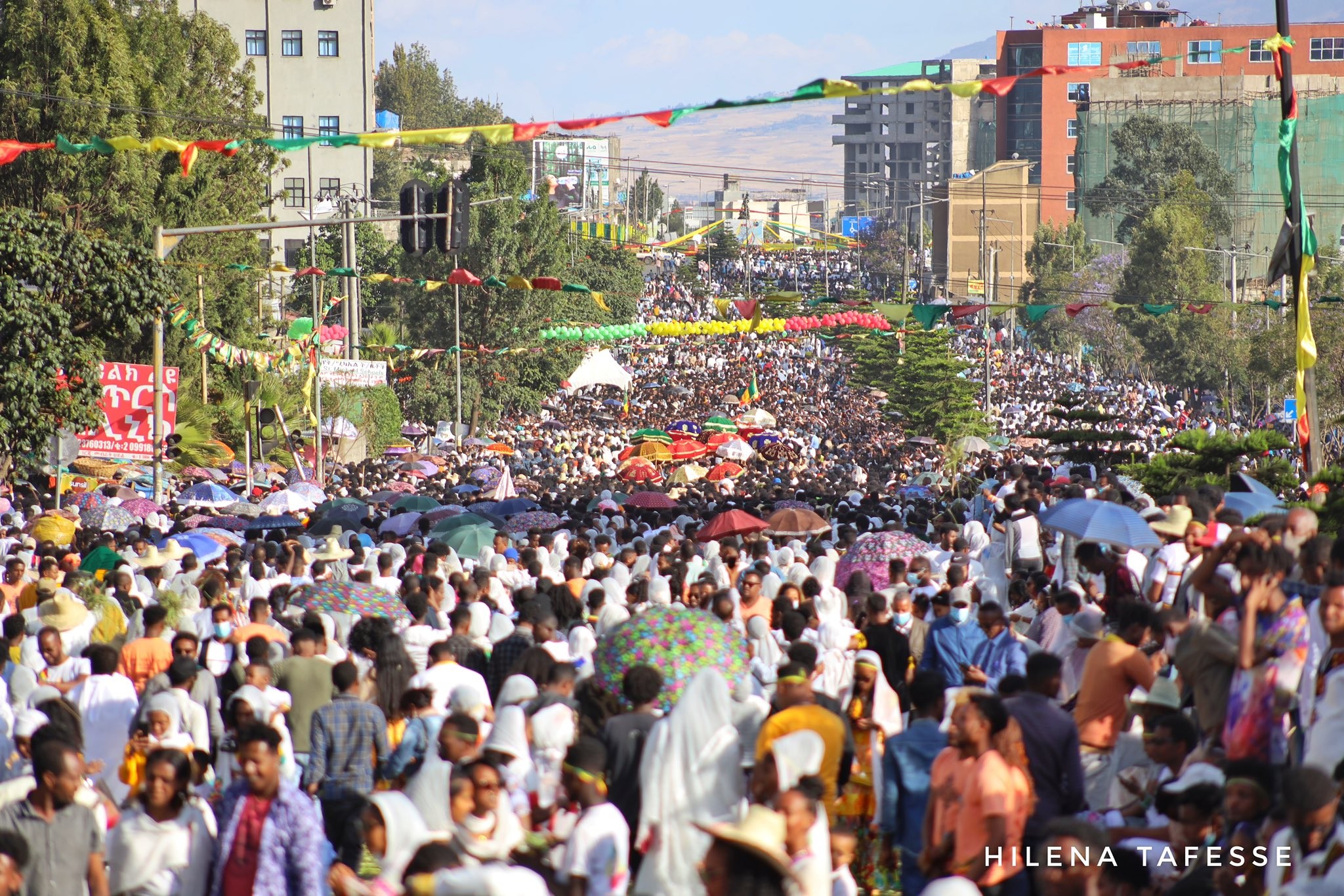
Most of the year the tabot stays hidden in the inner sanctuary, the Bete Mekdes, wrapped in rich cloth that only priests may lift. On a church’s own feast day, and above all at Timket, priests bring it out on their heads under bright umbrellas while the women in the crowd let out the long, high ululation called ilil. The procession usually circles the church three times before the tabot goes back inside.
Monday in Axum and in the diaspora
In Axum the feast begins the night before, on Sunday, with prayers, chanting and kebero drums that go on toward dawn. Pilgrims arrive from across Ethiopia and from abroad, many in white netela shawls, and on the morning of Hidar 21 the church courtyard fills for the liturgy and the procession. Anyone visiting should know that women are not permitted inside the old church, a rule the church keeps to this day.
Video: LENS MEDIA TUBE on YouTube
For families in the United States, the feast lands on a work and school day, so the night before and the early morning service matter more. Churches whose tabot is dedicated to Mary of Zion treat Hidar 21 as their own feast, and those are the parishes where you are most likely to see the tabot carried out. Elsewhere it is a day to dress in white, light a candle and call relatives back home, where the celebrations are hours ahead.
Hidar Tsion also opens the busy winter run of church holidays. Genna, Ethiopian Christmas, comes on Thursday, January 7, 2027, and Timket follows on Tuesday, January 19, when the tabots of churches across the country, and across the diaspora, go out in procession together. The full calendar is in our list of Ethiopian holidays for 2026 and 2027, and our Meskel guide tells the story of the bonfire feast that opened the season in September.