
Hidar Tsion (ህዳር ጽዮን) falls on Monday, November 30, 2026, the feast of Our Lady Mary of Zion at the holy church in Axum.
For Ethiopian Orthodox families, this is the next big church day on the calendar, and the one that pulls pilgrims to Axum. Hidar 21 in the Ethiopian year 2019 lines up with November 30 in most years. It is a major feast, but it is not a national day off, so many people go to church around work. In the United States it falls on a Monday this year, which means the same kind of juggling: an early liturgy, an evening service, or a long weekend trip if you can make one.
When Hidar Tsion Falls in 2026
The date is fixed on the Ethiopian calendar. Hidar 21 is November 30 in 2026, as it was in 2024 and 2025. In some years around an Ethiopian leap year it shifts to December 1, which is what happens in 2027. Our guide to Ethiopian holidays in 2026 and 2027 lists Hidar Tsion first in the table, ahead of Genna on January 7 and Timket on January 19.
The feast is also called the Feast of St Mary of Zion, Hidar Zion, or Axum Tsion. It is one of the principal Marian days in the Ethiopian Orthodox year, and Axum’s place as the church’s spiritual center is what makes the pilgrimage so important.
The Pilgrimage in Axum
The center of the feast is the Church of Our Lady Mary of Zion, in the old royal city of Axum in Tigray, near the famous stone stelae. Pilgrims travel there from across Ethiopia and from the diaspora, some of them on foot over several days. The vigil begins the night before. Chanting, kebero drumming and processions go on toward dawn, then the feast day itself fills the compound.
If you grew up in a church here in America, the sound will feel familiar even if you have never been to Axum: the priests’ chants, the drums, the white cotton netela on a major Mary day. In Axum the difference is the scale, and the sense that this particular church is the heart of the story.
The name itself is straightforward. Hidar is the third month of the Ethiopian calendar, and Tsion means Zion. The feast honors Mary under that title, and it is one of the principal Marian days of the year. Axum is also a UNESCO World Heritage site, listed for the ruins of the old royal city and for the tall carved stelae that still stand near the church. Many visitors walk the stelae field on the same trip, though the feast itself stays focused on the church compound.
The Old Church and the New Church
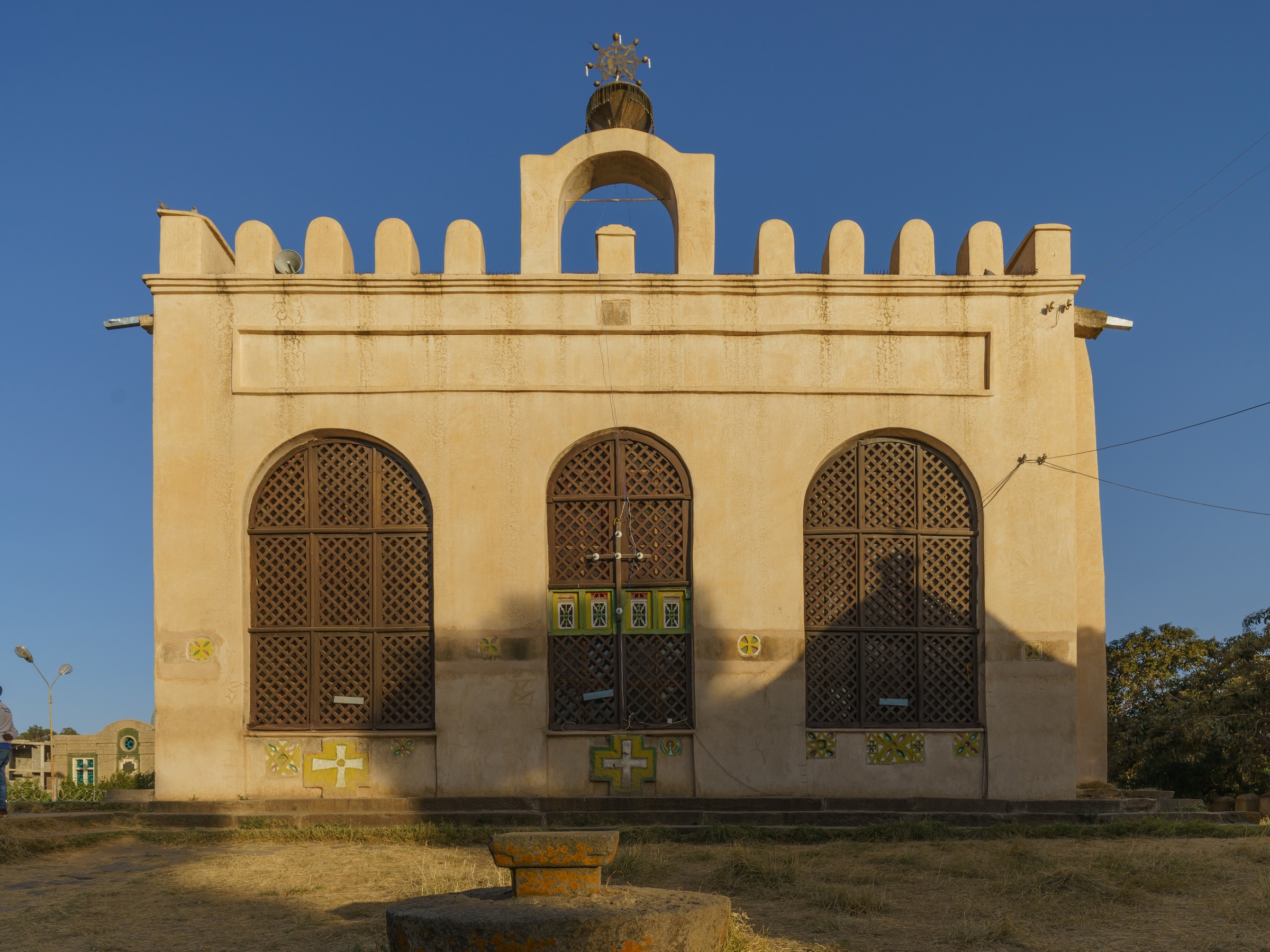
There are two main churches on the compound, and visitors often photograph both. Tradition says the first church on the site went up in the fourth century, in the time of King Ezana, when Axum became Christian. The building has been destroyed and rebuilt more than once. The present old church was rebuilt and enlarged in the seventeenth century under Emperor Fasilides. Women are not permitted inside the old church.
The new church, the large domed basilica that most visitors see first, was built under Emperor Haile Selassie and completed in 1964. It stands on the same grounds, with room for the crowds that arrive for the feast. This is the church most families will recognize from photographs, the broad dome and the colored windows looking over the paved courtyard. Ethiopian emperors were traditionally crowned at Mary of Zion, or had the coronation confirmed there, a sign of how closely the church and the old royal city were tied together.
The Ark of the Covenant Tradition
Ethiopian Orthodox tradition holds that this church is the resting place of the Ark of the Covenant. According to that tradition, the Ark came to Ethiopia with Menelik I after he visited his father, King Solomon, in Jerusalem. The claim is a matter of faith. Scholars have long debated it, and no independent examination is allowed, so it cannot be treated as a settled historical fact. It is, however, central to why so many people make the journey to Axum.
The Ark, the church says, is kept in the Chapel of the Tablet, next to the old church. Only the guardian monk may enter and see it. He is appointed for life, and the chapel is closed to everyone else, including other clergy and visiting dignitaries. Empress Menen Asfaw, the wife of Emperor Haile Selassie, funded the chapel that now stands there.
How Families Mark the Day
If you are not going to Axum, the day still belongs to church. In the United States, Canada and Europe, families typically go to their own Orthodox church on the day, as they do for other major feasts, and many wear white. It is a good day to take children, to light a candle, and to call relatives in Ethiopia, where the feast will already be under way by the time morning comes on the American East Coast.
Because it is not a public holiday in Ethiopia, and not a day off in the United States, plans tend to be practical. Some people attend the night before. Others go early on Monday or look for an evening service. Anyone traveling to Axum should remember the old church rule on women, and that the Chapel of the Tablet is not open to visitors at any time.
After Hidar Tsion the calendar moves toward Christmas. Genna is Thursday, January 7, 2027. Timket follows on Tuesday, January 19, with Ketera, the eve of the tabot processions, on Monday, January 18. Our Meskel guide walks through the Demera bonfires, and the holidays list also notes Gifaataa, the Wolaita New Year, among the other celebrations Ethiopian families keep.