Kirubel Assefa (ኪሩቤል አሰፋ), the Ethiopian bassist who played for years with Tilahun Gessesse, Mahmoud Ahmed and Aster Aweke, has released his new album, T.A.B.A., on Friday, November 20, on the Ethio Jazz Factory label.
The 11 song record is now on Apple Music, Spotify and Deezer. The label’s shop lists both a digital edition and a 33 rpm vinyl LP as out now.
The title is a short lesson in four letters. Each one stands for a qenet, the traditional modes that give Ethiopian songs their scale, their tuning and their mood: Tizita, Ambasel, Bati and Anchihoye. Anyone who grew up hearing Tizita at family gatherings knows the ache of that first mode, the sound of memory and longing. Kirubel has built a whole record around it and its three sisters.
The 11 Songs, From Yetizetaye to Malolo
Kirubel wrote all 11 compositions himself, then arranged, produced and recorded the album. He plays bass and keyboards on every track and guitar on all but one. Tewnet first wrote about the record earlier this month, before the album was out.
Side A holds Yetizetaye, Damgila, Adesse, Konjo Loga and Semada. Side B holds Addis 1887, Lebo Ney, Bonga, Enjemer Chewata, Mechot and Malolo.
The sound reaches back to Ethiopian records of the 1970s and 1980s and sets them beside jazz, funk, reggae, Afro Cuban grooves and West African rhythms. Saxophonist Randle Fisher plays on all but one track, Damgila, and Nolawi Kebede joins him on saxophone for six songs. Thomas Temesgen, known to many fans as Tommy T., and Huit Kilos both play guitar on Semada. Steve Tigerton plays guitar on Adesse, and Huit Kilos also appears on Konjo Loga and Bonga.
The drums are shared by Tosin Aribisala, Saddat Boakye and Max McVeete. Gustavo Ramirez plays keyboards on Lebo Ney, Enjemer Chewata and Malolo. Kris Jackson mixed the album in Los Angeles, and Raymond Valles mastered it there.
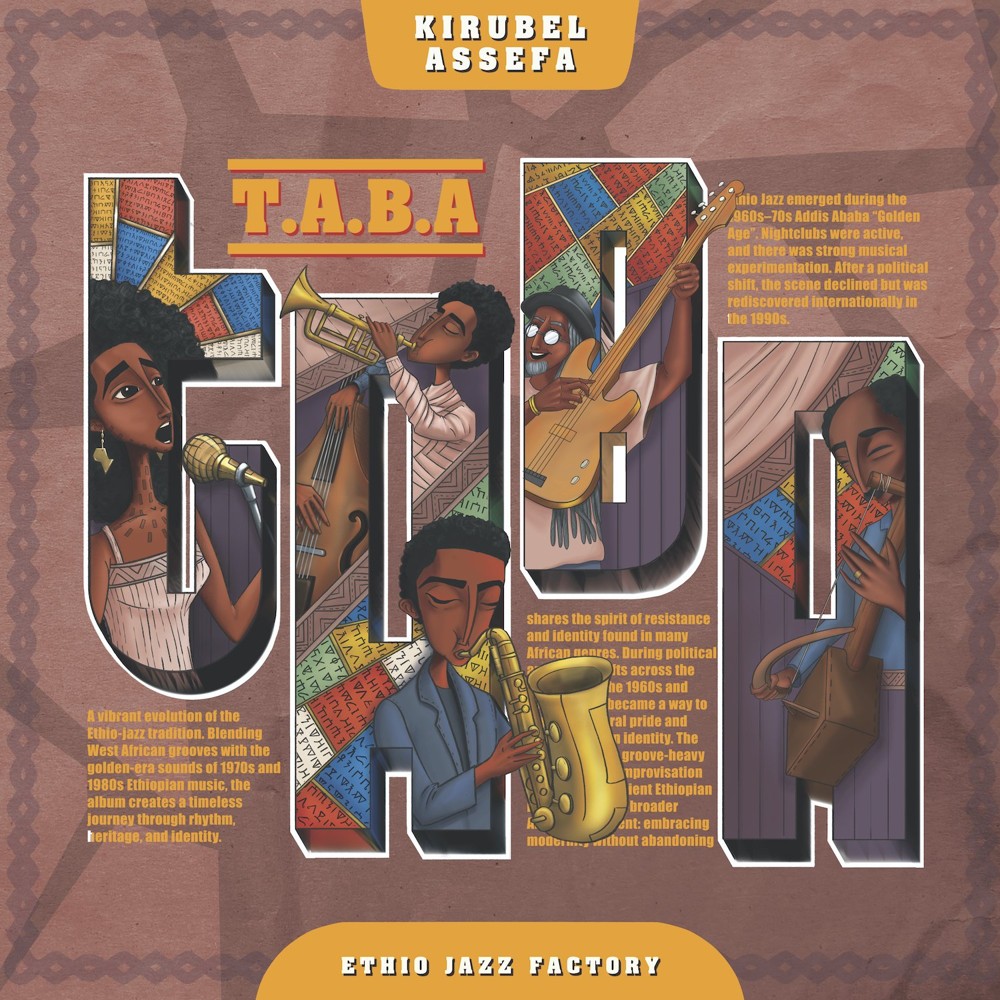
Kirubel sums up his aim as “modernizing Ethiopian music without Westernizing its identity.” In the album notes he puts it more simply: “I can bring in jazz, funk, African and Latin rhythms and still know where home is. The foundation remains Ethiopian.”
From a School Band in Addis Ababa to Los Angeles
Kirubel was born and raised in Addis Ababa, where he first played drums in the band at St. Joseph School. He started his musical life at 14 and later moved to the United States, where he picked up the bass, studied at Musicians Institute and played with reggae, funk and Cuban bands in the Bay Area and Los Angeles.
Over more than four decades he has worked as a player, arranger and musical director for some of the biggest voices in Ethiopian music, among them Tilahun Gessesse, Mahmoud Ahmed, Aster Aweke, Gigi and Tewodros Tadesse, and the Nigerian reggae star Majek Fashek. In Los Angeles he helped start Lasta Sound, which mixed Ethiopian melodies with young jazz players such as Kamasi Washington.
Mulatu Astatke, the father of Ethio jazz, finished his farewell tour late last year. Kirubel learned this music on the bandstand from that generation. “What I learned was not to preserve this music like something in a museum, but to know it deeply enough to move it forward. That is what T.A.B.A. means to me.”
Video: Kirubel Assefa on bass with his Dimtsepia Project band in a live set at Nyala, posted on his YouTube channel in January 2013 (Kirubel Assefa / YouTube) [file video]