Haile Gebrselassie (ኃá‹áˆŒ ገብረሥላሴ) won Olympic gold in the 10,000 meters in 1996 and 2000, took four straight world titles at the distance, set 27 world records and became the first man to run a marathon under 2:04, in Berlin in 2008.
For a whole generation of Ethiopians, Haile Gebrselassie was more than a runner. He was the smile on the television after every big race, the small man with the crooked left arm who seemed to win everything from the indoor 1500 meters to the marathon. His career lasted 25 years, and when he finally stopped racing in 2015 he had broken records on the track, on the roads and in the hour run. He also helped start the Great Ethiopian Run, which still fills the streets of Addis Ababa every November.
Haile Gebrselassie at a Glance
| Born | April 18, 1973, in Asella, Arsi |
| Nickname | The Emperor |
| Events | 1500m to the marathon, indoors, outdoors and on the road |
| Olympic medals | 2 gold, 10,000m (Atlanta 1996, Sydney 2000) |
| World titles outdoors | 4 at 10,000m (1993, 1995, 1997, 1999) |
| World indoor titles | 4 (3000m in 1997, 1500m and 3000m in 1999, 3000m in 2003) |
| World records | 27, plus 61 Ethiopian national records from 800m to the marathon |
| Marathon best | 2:03:59, Berlin 2008 (world record at the time) |
| Retired | May 2015, after the Great Manchester Run |
Ten Kilometers to School
Haile grew up on a farm near Asella, one of ten children. As a boy he ran about ten kilometers to school every morning and the same distance home every evening, and the story goes that this is where his famous running style came from. Even as a world champion he carried his left arm bent at his side, as if he were still holding his school books.
The world first heard his name in 1992. At the World Junior Championships in Seoul he won both the 5000 and the 10,000 meters, and that same year he took silver in the junior race at the World Cross Country Championships in Boston.
Four World Titles and a Lost Shoe
His first senior world title, at the 1993 World Championships in Stuttgart, came with a scene fans still talk about. At the bell in the 10,000 meters, Haile clipped the heel of Kenya’s Moses Tanui and the shoe flew off. An angry Tanui sprinted to a ten meter lead with one bare foot, but Haile ran him down in the home straight. He also took silver in the 5000 meters at those championships. He went on to win the 10,000 meters again in Gothenburg in 1995, Athens in 1997 and Seville in 1999, four titles in a row.
The records came just as fast. In 1994 he ran 12:56.96 for 5000 meters in Hengelo in the Netherlands, his first world record. A year later he cut the 10,000 meter record to 26:43.53 on the same track, then took almost 11 seconds off the 5000 meter mark in Zürich with 12:44.39. He and Kenya’s Daniel Komen traded the 5000 meter record in 1997, and Haile took it back in Helsinki in June 1998, running 12:39.36 with a last lap of 56.77 seconds. Earlier that month, in Hengelo, he had already reclaimed the 10,000 meter record with 26:22.75, running each half in almost exactly the same time.
Two Olympic Golds
Haile won his first Olympic title in Atlanta in 1996, running the 10,000 meters in 27:07.34 on a hard track that left his feet covered in blisters. Four years later in Sydney came one of the closest finishes in Olympic history. Kenya’s Paul Tergat ran his last 200 meters in 26.3 seconds, and Haile answered with 25.4 to win by just nine hundredths of a second, a smaller gap than in that year’s men’s 100 meter final. He became only the third man to defend the Olympic 10,000 meter title, after Emil Zátopek and Lasse Virén.
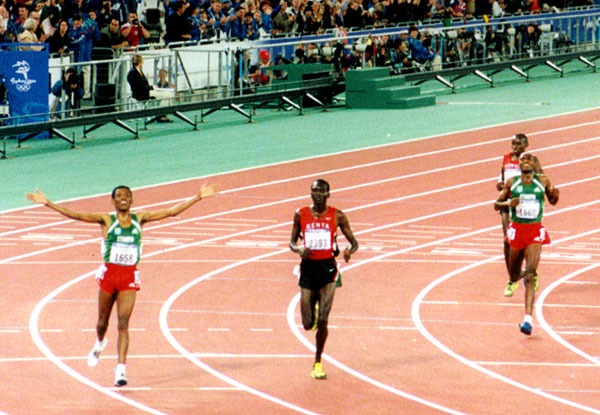
The 1999 film Endurance, in which Haile played himself, told the story of his road to that first gold. On the track he was almost untouchable in those years. He won every race he ran in 1999 and 2000, and in 1998 he shared the Golden League jackpot after winning all his races in the series.
Championship Medals
| Year | Championship | Event | Result |
|---|---|---|---|
| 1992 | World Junior Championships, Seoul | 5000m / 10,000m | Gold / Gold |
| 1993 | World Championships, Stuttgart | 10,000m / 5000m | Gold / Silver |
| 1995 | World Championships, Gothenburg | 10,000m | Gold |
| 1996 | Olympic Games, Atlanta | 10,000m | Gold |
| 1997 | World Indoor Championships, Paris | 3000m | Gold |
| 1997 | World Championships, Athens | 10,000m | Gold |
| 1999 | World Indoor Championships, Maebashi | 1500m / 3000m | Gold / Gold |
| 1999 | World Championships, Seville | 10,000m | Gold |
| 2000 | Olympic Games, Sydney | 10,000m | Gold |
| 2001 | World Championships, Edmonton | 10,000m | Bronze |
| 2001 | World Half Marathon Championships, Bristol | Half marathon | Gold |
| 2003 | World Indoor Championships, Birmingham | 3000m | Gold |
| 2003 | World Championships, Paris | 10,000m | Silver |
Passing the Torch to Kenenisa
By 2003 a younger man from Arsi was catching up. At the World Championships in Paris, Kenenisa Bekele beat Haile in a 10,000 meter final whose second half was run in 12:57, and in 2004 Kenenisa broke both of Haile’s track world records. At the Athens Olympics that summer Haile went for a third straight gold despite an inflamed Achilles tendon that had kept him from training for three weeks, and he finished fifth as Kenenisa won. After Athens, Haile turned to the roads.
The Marathon Years
His marathon debut in London in 2002 brought third place, and his first win came in Amsterdam in 2005. Berlin soon became his city. He won there four years in a row, from 2006 to 2009, and twice set the world record on its fast, flat streets: 2:04:26 in 2007, then 2:03:59 on September 28, 2008, the first marathon under 2:04. That record stood until 2011. He also won the Dubai Marathon three times, from 2008 to 2010. Berlin has stayed a lucky course for Ethiopians, as our list of Ethiopian marathon winners shows, and Tigst Assefa set a women’s world record there in 2023.
| Year | Marathon | Place | Time |
|---|---|---|---|
| 2002 | London | 3rd | 2:06:35 |
| 2005 | Amsterdam | 1st | 2:06:20 |
| 2006 | London | 9th | 2:09:05 |
| 2006 | Berlin | 1st | 2:05:56 |
| 2006 | Fukuoka | 1st | 2:06:52 |
| 2007 | Berlin | 1st | 2:04:26 (world record) |
| 2008 | Dubai | 1st | 2:04:53 |
| 2008 | Berlin | 1st | 2:03:59 (world record) |
| 2009 | Dubai | 1st | 2:05:29 |
| 2009 | Berlin | 1st | 2:06:08 |
| 2010 | Dubai | 1st | 2:06:09 |
| 2012 | Tokyo | 4th | 2:08:17 |
The road years brought more records at other distances too. In January 2006 he ran 58:55 for the half marathon in Arizona, a world record, and in June 2007 in Ostrava he covered 21,285 meters in one hour, breaking a record that had stood since 1991. Not every big day went his way. He dropped out of London in 2007 with breathing problems, and asthma and worries about air pollution kept him out of the Beijing Olympic marathon in 2008, a choice he later said he regretted.
One Last Lap and a Life After Racing
Haile announced his retirement after dropping out of the New York City Marathon in November 2010, then changed his mind within days. He kept racing for almost five more years, winning the Great Manchester Run again in 2011 and 2012 and the Vienna half marathon three times, and in 2013 he set a world best for men over 40 at ten miles. He finally said goodbye after the Great Manchester Run on May 10, 2015. “I’m retiring from competitive running, not from running,” he told the BBC. “You cannot stop running, this is my life.”
Off the track, Haile became one of Ethiopia’s best known businessmen, with hotels including Haile Resort in Hawassa, a Hyundai dealership and Marathon Motors, which began assembling electric cars in Addis Ababa in 2020. He also grows coffee under the Haile Estate name. He received the Prince of Asturias Award for Sports in 2011, carried the Olympic flag into the stadium at the London 2012 opening ceremony, and later served as president of the Ethiopian Athletics Federation. He married his wife, Alem, in 1996.
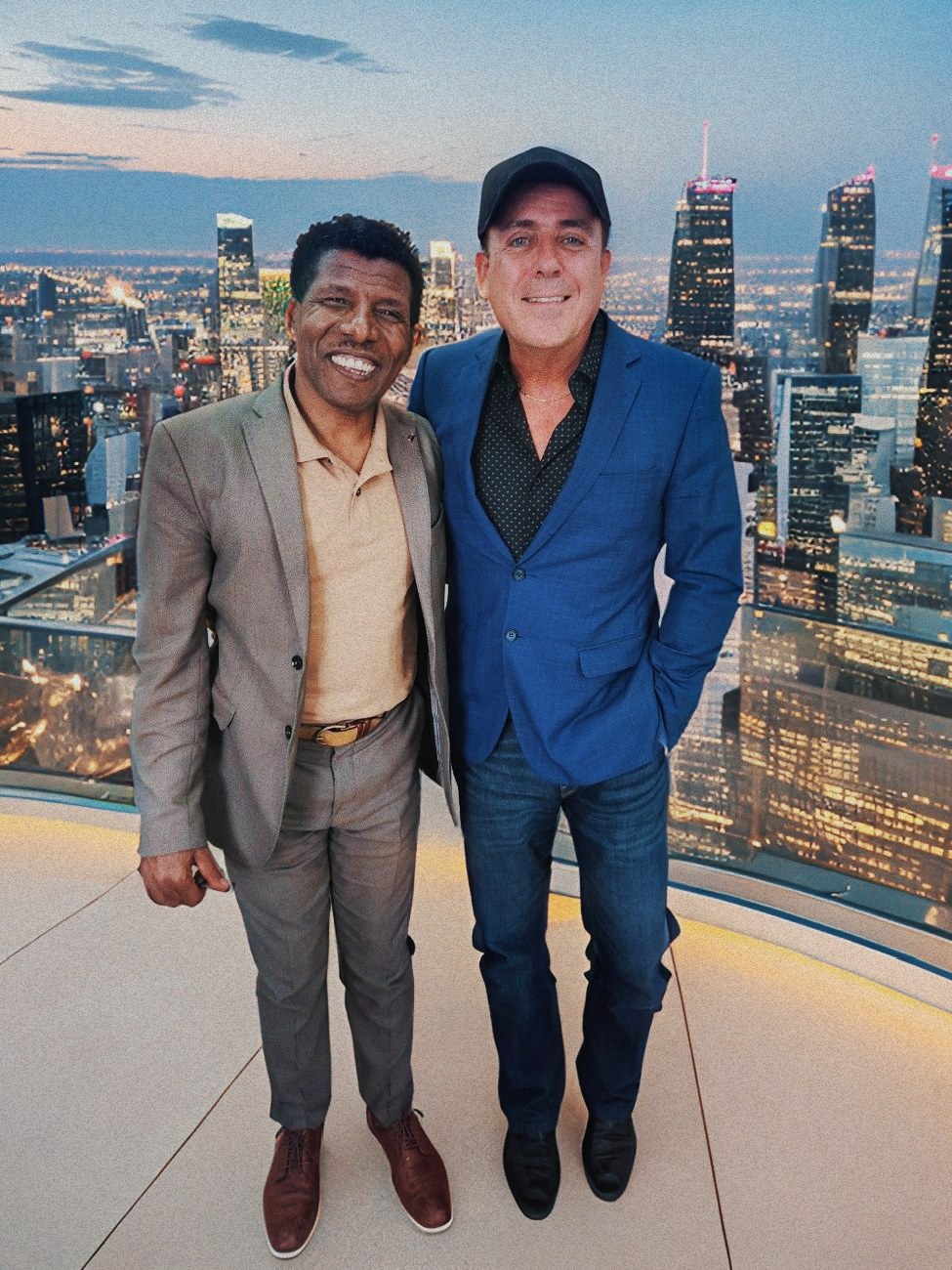
The race he dreamed up in 2001 with Middlebrook, later backed by the British runners Brendan Foster and Richard Nerurkar, may be his warmest legacy at home. Every year it brings tens of thousands of ordinary Ethiopians, from schoolchildren to grandparents, onto the streets of the capital.
Video: Haile Gebrselassie and Paul Tergat in the final sprint of the 10,000 meters at the Sydney 2000 Olympics, from the Olympic Games YouTube channel (Olympic Games / YouTube) [file video]