Abebe Bikila (አበበ ቢቂላ) won the Olympic marathon barefoot in Rome in 1960 and won it again in shoes in Tokyo in 1964, both times in a world best. He was Ethiopia’s first Olympic champion and the first man ever to win the Olympic marathon twice.
More than sixty years later, his name is on a stadium in Addis Ababa, an award in New York and a plaque in Rome, and Ethiopian runners still grow up on stories of the barefoot soldier from Shewa. His life also had a hard second half, because a car crash in 1969 left him paralyzed and he died at only 41.
Abebe Bikila at a Glance
| Full name | Shambel Abebe Bikila (ሻምበል አበበ ቢቂላ); shambel means captain |
| Born | August 7, 1932, in Jato, in the Selale area of Shewa |
| Died | October 25, 1973, in Addis Ababa, aged 41 |
| Event | Marathon |
| Coach | Onni Niskanen, a Swedish coach hired to train the Imperial Guard |
| Olympic golds | Rome 1960 (2:15:16.2, barefoot) and Tokyo 1964 (2:12:11.2) |
| Marathons | 16 started, 12 wins, plus a second place in his first race and fifth at Boston in 1963 |
| Best known for | First Ethiopian Olympic champion, first man to win two Olympic marathons |
From Jato to the Imperial Guard
Abebe was born on August 7, 1932, in the small village of Jato, in the Selale district of Shewa, north of Addis Ababa. By a lovely coincidence, that was the same day the marathon was run at the 1932 Los Angeles Olympics. His family farmed, and as a boy he played gena (ገና), the traditional Ethiopian hockey game where the goals can sit kilometers apart and a single match can turn into a long run across the fields.
He moved to Addis Ababa as a young man and joined the Imperial Guard around 1952. In the mid 1950s he used to run about 20 kilometers a day, from the hills of Sululta into the city and back. That habit caught the eye of Onni Niskanen, the Swedish coach the government had brought in to train the guardsmen, and Niskanen started preparing him for the marathon. In 1956 Abebe finished second to Wami Biratu at the Armed Forces championship, his first marathon.
In the summer of 1960 he won two marathons in Addis Ababa. The second one, in August, took 2:21:23, faster than the Olympic record Emil Zátopek had set eight years earlier. Niskanen put him on the plane to Rome.
Rome 1960: The Barefoot Gold
In Rome, Abebe bought a new pair of running shoes, but they did not fit and gave him blisters. He decided to run without them.
Because of the heat, the race on September 10 started late in the afternoon at the foot of the Capitoline Hill and finished after dark at the Arch of Constantine, next to the Colosseum. The course passed twice by the Obelisk of Axum, which was standing in Rome at the time. By about 25 kilometers only Morocco’s Rhadi Ben Abdesselam could stay with him, and the two ran side by side along the Appian Way, lit by Italian soldiers holding torches.
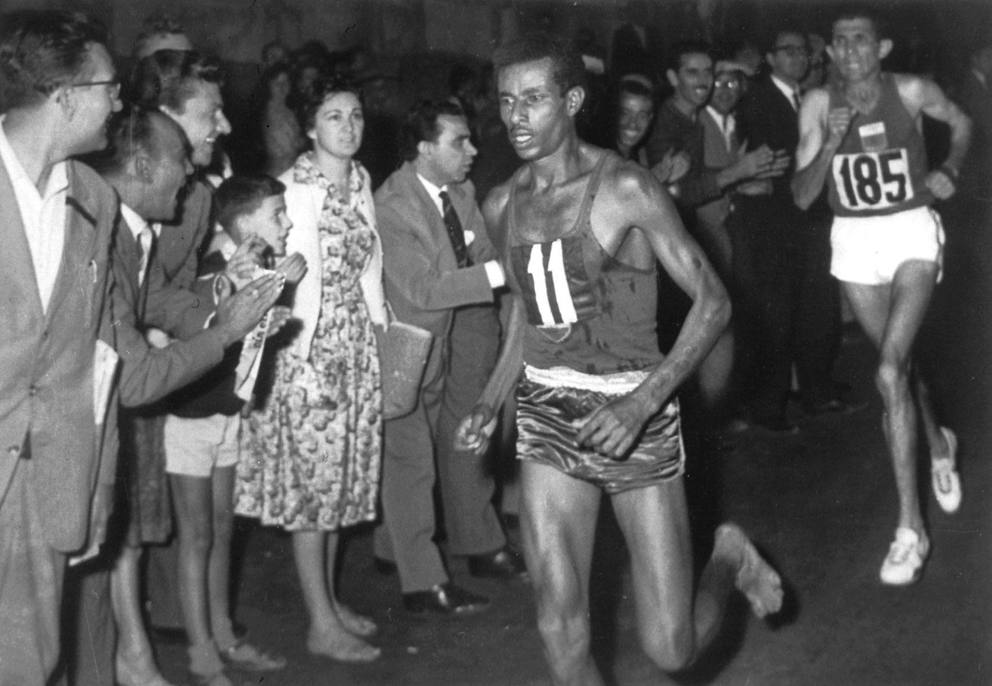
With about 500 meters left, near the obelisk again, Abebe sprinted. He crossed the line in 2:15:16.2, twenty five seconds ahead of Ben Abdesselam and eight tenths of a second faster than the world best held by the Soviet runner Sergei Popov. New Zealand’s Barry Magee took bronze. Abebe then calmly touched his toes and jogged in place, and later said he could have run another 10 to 15 kilometers.
He came home to huge crowds in Addis Ababa and received the Star of Ethiopia, along with a promotion in the guard.
Between the Games
Abebe kept winning. In 1961 he took the Athens marathon, barefoot for the second and last time, and then won in Osaka in Japan and in Košice in what was then Czechoslovakia. In Japan, the shoe company Onitsuka Tiger hoped to put him in their shoes, but Niskanen said he had other commitments.
His only completed international marathon without a win came at Boston in 1963. Abebe and his teammate Mamo Wolde ran on record pace for 18 miles before cold wind and the Newton hills slowed them both, and Abebe finished fifth in 2:24:43.
Tokyo 1964: Gold Five Weeks After Surgery
About forty days before the Tokyo Olympics, Abebe felt sharp pain while training in Debre Zeit (Bishoftu). Doctors found acute appendicitis, and he had his appendix removed on September 16. He was out of the hospital within a week.
On October 21 he lined up in Tokyo wearing Puma shoes. He ran behind the leaders early, moved to the front shortly before 20 kilometers and kept pulling away. He entered the Olympic stadium alone, to the cheers of about 75,000 fans, and won in 2:12:11.2, another world best, more than four minutes clear of Britain’s Basil Heatley. Japan’s Kokichi Tsuburaya took bronze. Once again Abebe did not look tired at all, and he went straight into a little routine of stretching and leg exercises.
No one had ever won the Olympic marathon twice before. Only two men have matched him since, Waldemar Cierpinski of East Germany and Eliud Kipchoge of Kenya, and both of them also did it at back to back Games.
Mexico City 1968 and the Last Races
Abebe won the Mainichi marathon in Japan again in 1965, and in 1966 he won in Zarautz, Spain, and in Seoul, South Korea. The Seoul race was the last marathon he ever finished. In 1967 he hurt his hamstring and dropped out at Zarautz, and the leg never fully recovered.
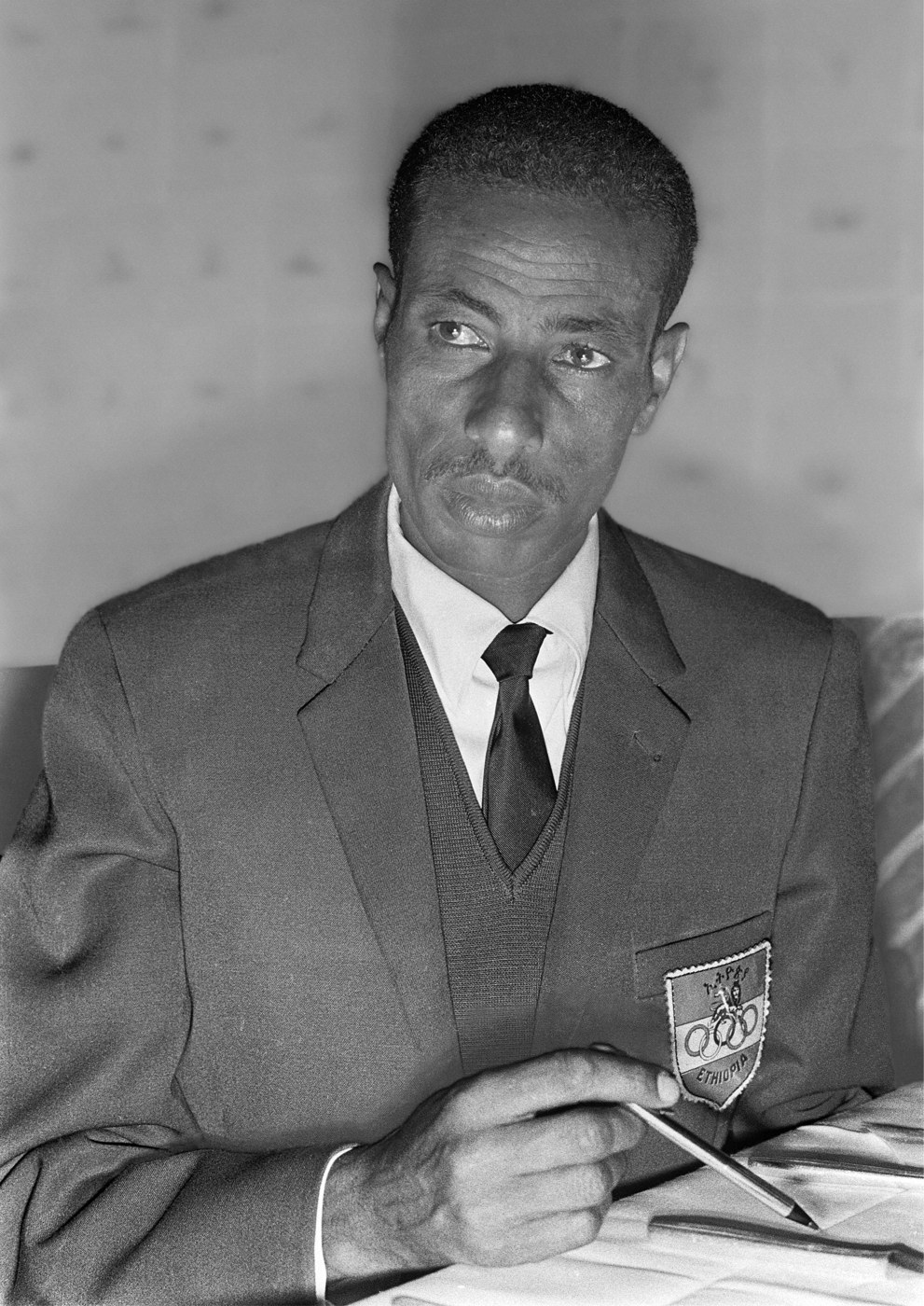
He still went to the Mexico City Olympics in 1968 chasing a third gold, and he was given bib number 1. A week before the race doctors found a fracture in his left fibula. He started anyway and stopped after about 16 kilometers. His teammate Mamo went on to win the gold, so the title stayed in Ethiopian hands.
The Accident and His Final Years
On the night of March 22, 1969, Abebe lost control of his Volkswagen Beetle and the car overturned, trapping him inside until the next morning. The crash left him paralyzed. He was taken to Stoke Mandeville Hospital in England, where he spent eight months in treatment and slowly got back the use of his arms, though he never walked again.
He did not stop competing. In 1970 he took part in archery and table tennis at the Stoke Mandeville Games in London, an early forerunner of the Paralympics. In 1971, at games for disabled athletes in Norway, he won a cross country sled dog race against a field of sixteen. At the 1972 Munich Olympics he was a special guest and received a standing ovation at the opening ceremony.
Abebe died in Addis Ababa on October 25, 1973, at age 41, from a brain hemorrhage linked to the accident four years before. About 65,000 people attended his state funeral, and a national day of mourning was declared. He is buried at Saint Joseph Church in Addis Ababa, where a bronze statue stands over his tomb.
Abebe Bikila’s Marathon Results
| Year | Race | Place | Result |
|---|---|---|---|
| 1956 | Armed Forces championship, Addis Ababa | 2nd | |
| 1960 | Armed Forces championship, Addis Ababa | 1st | 2:39:50 |
| 1960 | Olympic trials, Addis Ababa | 1st | 2:21:23 |
| 1960 | Olympic Games, Rome | 1st | 2:15:16.2 (world best, barefoot) |
| 1961 | Athens marathon, Greece | 1st | 2:23:44.6 (barefoot) |
| 1961 | Mainichi marathon, Osaka, Japan | 1st | 2:29:27 |
| 1961 | Košice marathon, Czechoslovakia | 1st | 2:20:12.0 |
| 1963 | Boston marathon, United States | 5th | 2:24:43 |
| 1964 | Armed Forces championship, Addis Ababa | 1st | 2:23:14.8 |
| 1964 | Olympic trials, Addis Ababa | 1st | 2:16:18.8 |
| 1964 | Olympic Games, Tokyo | 1st | 2:12:11.2 (world best) |
| 1965 | Mainichi marathon, Shiga, Japan | 1st | 2:22:55.8 |
| 1966 | Zarautz marathon, Spain | 1st | 2:20:28.8 |
| 1966 | Incheon to Seoul marathon, South Korea | 1st | 2:17:04 |
| 1967 | Zarautz marathon, Spain | Did not finish | |
| 1968 | Olympic Games, Mexico City | Did not finish |
A Legacy That Still Runs Through Addis Ababa
Abebe is widely seen as the man who started East Africa’s long run at the top of distance running. Five years after his death, the New York Road Runners created the Abebe Bikila Award for people who have done great things for long distance running. Mamo Wolde, Tanzania’s Juma Ikangaa, Kenya’s Tegla Loroupe and Paul Tergat, and Haile Gebrselassie have all received it. Haile’s own career guide shows how far that road went, and our list of Ethiopian marathon winners by year is full of runners who grew up hearing Abebe’s story.
In Addis Ababa, Abebe Bikila Stadium (አበበ ቢቂላ ስታዲየም) carries his name, as do many schools and events. Rome has not forgotten him either. In 2010 the Rome Marathon marked fifty years since his win, and the winner that day, Ethiopia’s Siraj Gena, ran the last 300 meters barefoot in his honor. A plaque on Via di San Gregorio remembers the 1960 race, and a footbridge in nearby Ladispoli is named after him.
His story has been told many times on screen and on paper. Kon Ichikawa’s 1965 film Tokyo Olympiad shows his Tokyo win, and the 2009 feature film Atletu (The Athlete), directed by Davey Frankel and Rasselas Lakew, follows his last years. His daughter, Tsige Abebe, wrote the biography Triumph and Tragedy, published in Addis Ababa in 1996, and the British writer Tim Judah later wrote a full biography of his life. We also looked back at his life in an earlier piece, Remembering Abebe Bikila.
The Olympic Games channel on YouTube has a short clip of Abebe’s barefoot win in Rome.