
Éthiopiques is a series of 32 CDs from the Paris label Buda Musique that, since 1997, has brought the Ethiopian records of the 1960s and 1970s back into print and out to listeners around the world.
If you grew up in an Ethiopian home in America, you probably heard these songs first on a cassette in your parents’ car, or at a wedding when the DJ finally gave the older guests what they wanted. What you may not know is that a lot of non-Ethiopian fans of Mahmoud Ahmed and Mulatu Astatke first found them through one long row of numbered CDs. That row is Éthiopiques.
A record that started it all
The man behind the series is Francis Falceto, a French producer who fell for Ethiopian music in the 1980s after hearing Mahmoud’s album Erè Mèla Mèla. He spent years tracking down the original singles and LPs, many of them made by small Addis Ababa labels such as Amha Records, run by Amha Eshete, and Kaifa Records, run by Ali Abdella Kaifa, better known as Ali Tango, along with Philips-Ethiopia.
Those records come from a short, bright window. In the late 1960s and early 1970s, Addis Ababa had hotel bands, horn sections, nightclubs and a young crowd that wanted soul and funk sung in Amharic, Tigrigna and Oromo. After the 1974 revolution brought the military Derg to power, curfews hit the night scene hard, and by the middle of the decade cassettes were pushing vinyl out of the market. Many of those discs were scratched, lost or sitting in boxes by the time Falceto went looking.
Buda Musique released the first volume, Golden Years of Modern Ethiopian Music 1969-1975, in 1997. According to the label, the first song on the very first disc was Hédètch Alu, the B-side of the debut single by Muluken Melesse (ሙሉቀን መለሰ), released by Amha in February 1972 when he was not yet 18.
Every volume, from 1 to 32
The series does not move in a straight line. Some discs gather many singers, some give one star the whole album, and a few leave the nightclub behind for church harps, village songs and street musicians. Years below are for the first CD release.
| Vol. | Year | Title | Artist |
|---|---|---|---|
| 1 | 1997 | Golden Years of Modern Ethiopian Music 1969-1975 | Various |
| 2 | 1997 | Tètchawèt! Urban Azmaris of the 90s | Various |
| 3 | 1998 | Golden Years of Modern Ethiopian Music 1969-1975 | Various |
| 4 | 1998 | Ethio Jazz & Musique Instrumentale 1969-1974 | Mulatu Astatke |
| 5 | 1999 | Tigrigna Music | Various |
| 6 | 1999 | Almaz | Mahmoud Ahmed |
| 7 | 1999 | Erè Mèla Mèla | Mahmoud Ahmed |
| 8 | 2000 | Swinging Addis | Various |
| 9 | 2001 | Alèmayèhu Eshèté 1969-1974 | Alemayehu Eshete |
| 10 | 2002 | Tezeta: Ethiopian Blues & Ballads | Various |
| 11 | 2002 | The Harp of King David | Alemu Aga |
| 12 | 2003 | Konso Music and Songs | Various |
| 13 | 2002 | Ethiopian Groove: The Golden Seventies | Various |
| 14 | 2003 | Negus of Ethiopian Sax | Getatchew Mekurya |
| 15 | 2003 | Europe Meets Ethiopia | Jump to Addis |
| 16 | 2003 | The Lady With the Krar | Asnaketch Worku |
| 17 | 2004 | Tlahoun Gèssèssè | Tilahun Gessesse |
| 18 | 2004 | Asguèbba! | Various |
| 19 | 2005 | Alèmyé | Mahmoud Ahmed |
| 20 | 2004 | Live in Addis | Either/Orchestra and guests |
| 21 | 2006 | Piano Solo | Emahoy Tsegué-Maryam Guèbrou |
| 22 | 2007 | More Vintage! 1972-1974 | Alemayehu Eshete |
| 23 | 2007 | Orchestra Ethiopia | Orchestra Ethiopia |
| 24 | 2008 | Golden Years of Modern Ethiopian Music 1969-1975 | Various |
| 25 | 2009 | Modern Roots 1971-1975 | Various |
| 26 | 2010 | Mahmoud Ahmed & the Imperial Bodyguard Band 1972-74 | Mahmoud Ahmed |
| 27 | 2011 | Centennial of the First Ethiopian Music Recordings | Azmari Tessema Eshete |
| 28 | 2013 | Great Oromo Music | Ali Birra |
| 29 | 2014 | Mastawesha | Kassa Tessema |
| 30 | 2017 | Mistakes on Purpose | Girma Beyene and Akalé Wubé |
| 31 | 2025 | Muluken Mèllèssè | Muluken Melesse |
| 32 | 2025 | Nalbandian the Ethiopian | Either/Orchestra and Ethiopian guests |
The stars who got their own discs
Mahmoud has more volumes than anyone, four in all, from the 1973 album Almaz to a set of 1972 to 1974 recordings with the Imperial Bodyguard Band, the band of Emperor Haile Selassie’s palace guard. You can follow the rest of his story in our Mahmoud Ahmed discography. Alemayehu Eshete, the singer fans called the Abyssinian Elvis, got two discs of his own, and Tilahun Gessesse got one.
The most famous single volume may be number 4. Mulatu’s instrumental Ethio-jazz from the late 1960s and early 1970s reached a whole new audience when the director Jim Jarmusch used several of its tracks in his 2005 film Broken Flowers, starring Bill Murray. Yègellé Tezeta is one of the songs you hear in the film. Our Mulatu Astatke guide picks up the story from there.
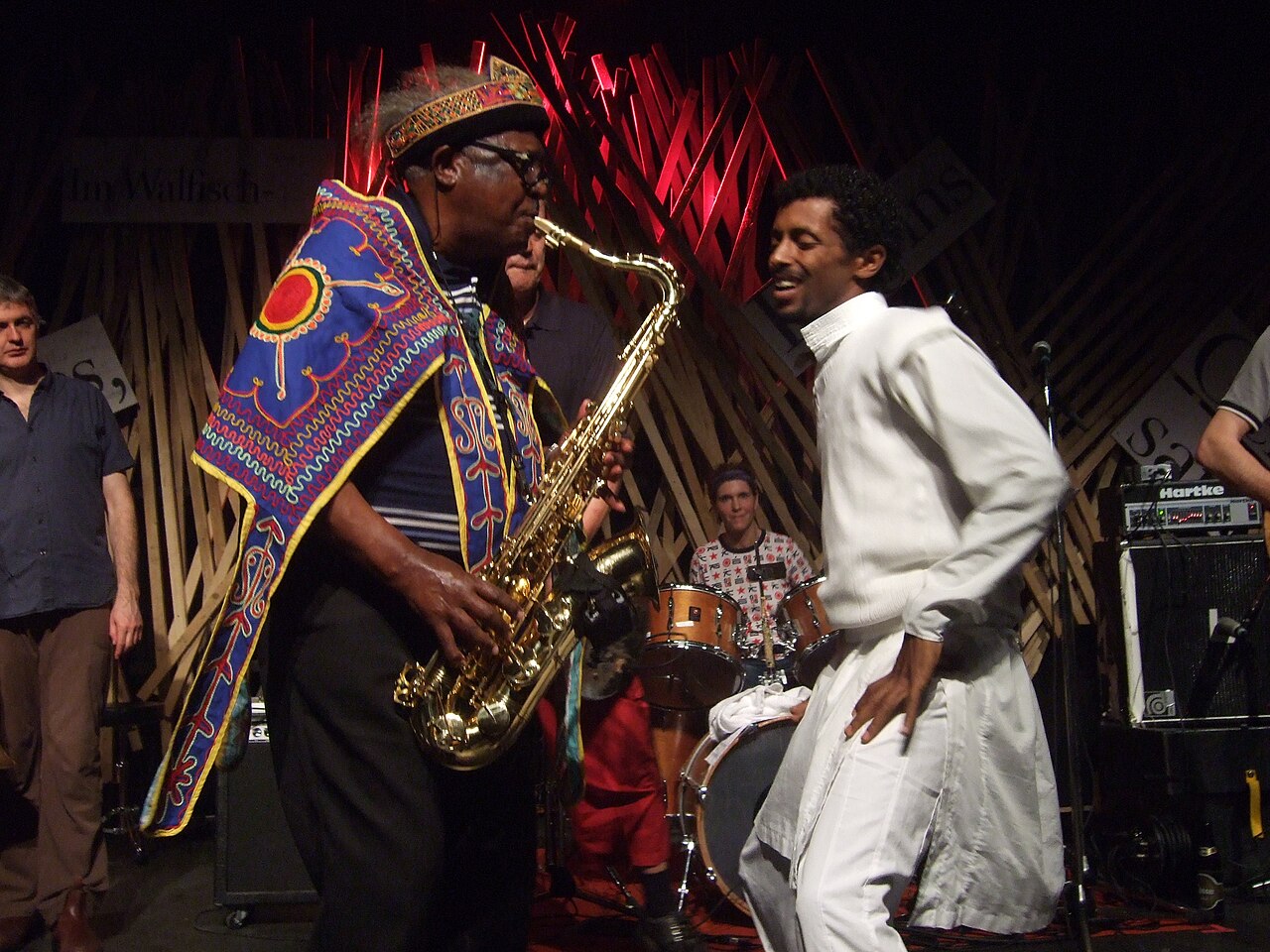
File photo: Saxophonist Getatchew Mekurya plays on stage with dancer Melaku Belay in November 2008 (Andy Newcombe / Wikimedia Commons, CC BY 2.0)
Getatchew Mekurya, the subject of volume 14, played the saxophone like a war cry. His style drew on shellela, the boastful chant warriors once sang before battle, and the CD gave him a second career in his later years, including tours with the Dutch punk band The Ex. He died in 2016.
Harps, fiddles and a nun at the piano
Some of the most moving discs have nothing to do with nightclubs. Alemu Aga plays the begena, the large ten-string lyre that Ethiopian Orthodox Christians link to King David and use for prayerful songs, especially during fasting seasons. Asnaketch Worku sings with the krar, the smaller five- or six-string lyre that is a regular at azmari houses, the bars where singers trade witty verses with the crowd. Kassa Tessema brings the masenqo, the one-string fiddle, and volume 27 goes back further than any other, to recordings made by the azmari Tessema Eshete in 1910.
Volume 21 belongs to Emahoy Tsegué-Maryam Guèbrou, an Ethiopian Orthodox nun whose gentle, rolling piano pieces sound like nothing else in the series. Emahoy, a title for a nun, spent her last decades in a monastery in Jerusalem and died there in 2023 at age 99. Her music has found listeners far beyond Ethiopian circles.
The regional volumes are worth a listen too: Tigrigna songs on volume 5, music from the Konso people of southern Ethiopia on volume 12, and Oromo music from Ali Birra, the singer from Dire Dawa, on volume 28.
Two new volumes after eight quiet years
After volume 30 in 2017, the series went quiet until Buda Musique added two volumes in 2025. Volume 31 goes back to where the whole thing started. It is built around Muluken’s 1976 LP for Kaifa Records, one of the last vinyl albums made in Ethiopia before cassettes took over, released when he was not yet 22. Muluken later became a born again Christian and gave up secular music. He died in Washington, D.C., in April 2024.
Volume 32 tells a story most young Ethiopians have never heard, about Nersès Nalbandian, an Armenian-born musician and teacher who helped shape modern music in Addis Ababa in the 1950s and was granted Ethiopian citizenship in 1957. The label credits him as a godfather of the Swinging Addis sound, and the Boston band Either/Orchestra, which also made volume 20, recorded his music with Ethiopian guests.
Many of the singers in the series are gone now, as our look at where the golden age stars are in 2026 shows, but the records keep finding new ears. Hédètch Alu, the Muluken song that opened volume 1, also appears on the new volume 31.